
By now, you’ve probably heard about Bluey, the wildly popular Australian kids show about a family of dogs.
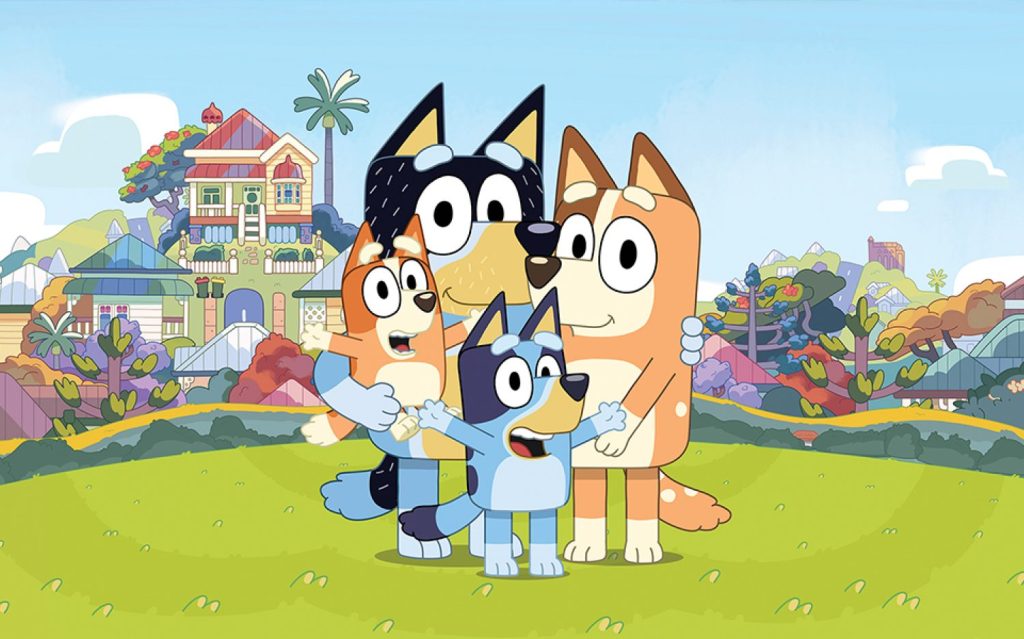
Although it’s created primarily for kids ages 4-7, the show has themes and topics that have moved audiences of all ages. They can be a fun way to introduce or review topics in the high school classroom.
Disclaimer: This will work if you work in a school, district, state, and teaching environment that allows you to use pop culture as a means of engaging students. You will need access to Disney+.
About me: I have taught high school English Language Arts for 12 years, most of those as an AP/Pre-AP/GT/Advanced track teacher. My most recent assignment was as an AP Lang and American Studies (AP Lang + APUSH) teacher. My favorite lessons are ones where I get to connect our otherwise boring English lessons to something that is visually engaging and culturally relevant for kids. Many of the following are episodes and lessons I’ve shown my students, who both enjoyed the lesson and got meaningful AP writing and thinking practice out of it.
Literature Studies: Bingo and The Hero’s Journey

Bluey and Rhetorical Analysis: Writing About Layered Messages For Different Audiences
Like many kids shows, Bluey has an awareness of two audiences: children, and the adults watching with them. Students can practice a challenging writing task by analyzing the rhetorical strategies the creators use to convey the different messages to each audience.
Students must be able to clearly transition between ideas and keep a cohesive paragraph — this is harder than it looks! I did this with my students in the spring, when we were all tired of practicing with traditional AP texts. This proved to be a meaningful practice day because the “text” (Bluey) seemed easy, but actually articulating the different layers in the episode was difficult. I got to evaluate their organization and clarity. I didn’t take a grade on it, so this ended up being a low-stakes formative assessment that packed a mighty punch!
You can do this with almost any Bluey episode. Here are my favorites:
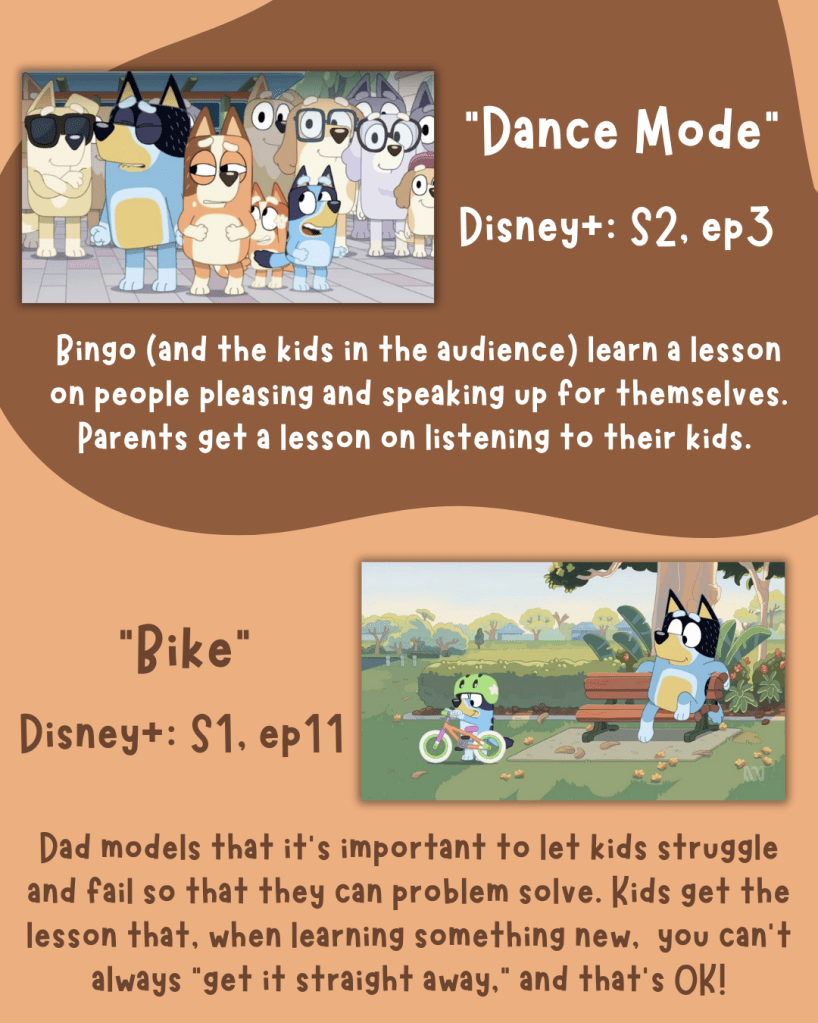
Thematic Discussion: Parenting Roles, Gender Roles, and Bluey
In American Studies and APUSH, we discuss changes in women’s roles by marking different societal pressures placed on women throughout history, particularly regarding parenting. We usually start with Republican Motherhood, and keep revisiting the idea throughout the entire year.
Because classroom discussions about parenting keep falling primarily on women and may perpetuate pressures placed on women, I like any chance I can to expand the topic of parenting to one that includes fathers. And Bluey’s dad, Bandit, is someone we all see as the perfect dad who puts us all to shame!
This is another one where you can pick from several episodes, but here are my favorites for this topic!

I used these with my American Studies students, and it was a good way to conclude our Republican Motherhood lesson with a real-world application of parenting expectations.
Abstract Lessons for More Creative Thinkers
I love these artsy-fartsy ones. They’re a great way to stretch your brain in class.

I would use this to…
- stretch the brains of 9th/10th/AP Lit kids who are learning how to write out thematic statements
- give AP Lang kids something that’s more unusual than what they usually see in their more concrete nonfiction class.
There are So Many More!
If you’re a Bluey parent like me, you know that every episode is jam-packed with lessons for kids and adults. If you’re a teacher who’s looking to create a Bluey lesson, stick to the ones that you love! Here are others I would love to use if I could find a place for them:
- “Camping”: The theme about friendship and the pain of growing up is something that all adults can relate to. This would be lovely for a theme lesson.
- “Perfect” and “Stories”: These episodes look into the idea of perfectionism and developing a healthy growth mindset. I would use this with my GT kids who get bogged down in the details, or my students who are new to a PBL environment
- “Rain”: If I still taught AP Lit, this is the Bluey episode I’d go for. It has no words and you only rely on the music and visuals. You could even explore overlapping themes in the featured song. The episode has the instrumental version, but you can find the lyrical song on the Bluey soundtrack.
Hope you have fun with these! My students loved having a Bluey Day to practice their skills and take a break from traditional texts.
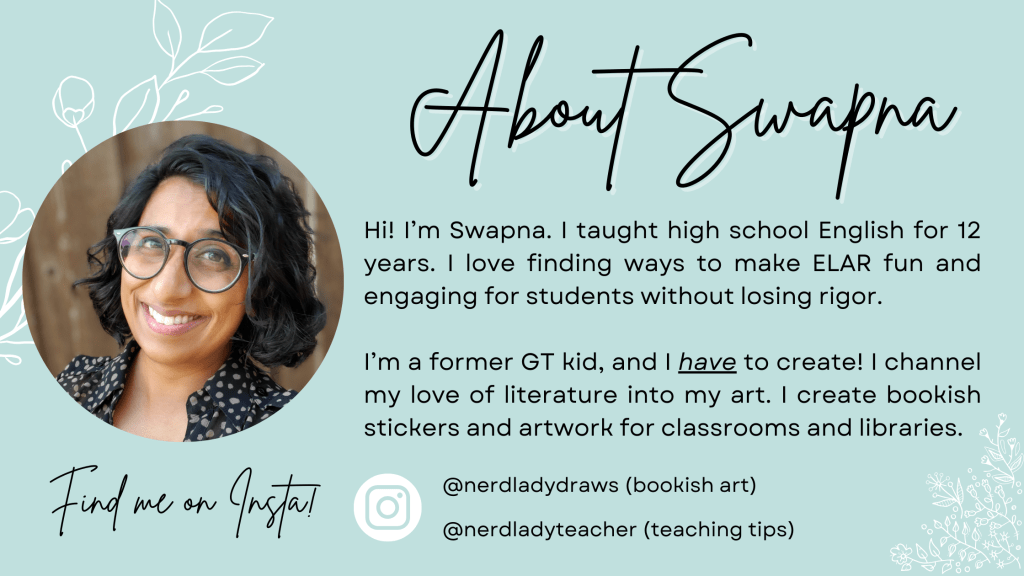
 NLD x Swapna