Children of immigrants, particularly first generation and second generation, have a unique struggle with identity.
I am the firstborn of all of my generation in my family, and the first to be born and raised in the United States. At school, I stood out because of my name and my skin. But I didn’t belong in India, either. I gradually became more and more of a foreigner on each of our summer trips back to Kerala: my clothes, my tastes, my Malayalam heavily laced with an American accent. On my last trip to Kerala as a teenager, I was too embarrassed by my accent to even try to speak to my family.
Growing up first/second gen means holding more than one culture and language in our hearts.
It means having a complex tie to history. In our birthplace, we do not see or hear the story of our family’s nation and heroes; in our schools, the nation and heroes we learn of have no tie to our families.
It means fearing losing touch with our family’s language and traditions, and not knowing what it means for our own children and grandchildren.
It means feeling varying shades of both pride and shame for each part of us.
It means eventually accepting that we are multicultural individuals, and that not everyone else will understand that.
Studying Perspectives of Children of Immigrants in the High School ELAR Classroom
I have had the amazing experience of teaching hundreds of teenagers with experiences similar to my own as a child of immigrants. As an educator, it was a mission of mine to be the kind of role model I wish I had as a kid: someone who understood the struggles of being multicultural, and provided room to explore and find pride in that multifaceted identity.
While teaching AP Lang and American Studies (a blended AP Lang + APUSH course), I came across the following texts, and I have not been able to stop thinking about them since. For my students, these texts helped validate their experience, allowed them to see themselves in our English curriculum, and opened dialogue for the entire class to gain a deeper understanding of the experience of immigrants and their families.
Because I revise and edit my lessons every year, I was not always able to organically build these videos into our unit flow. But when I did, our class discussions sparkled… and there may have been a few tears when students saw themselves in these videos. I hope these give you some ideas to bring in the experience of children of immigrants!
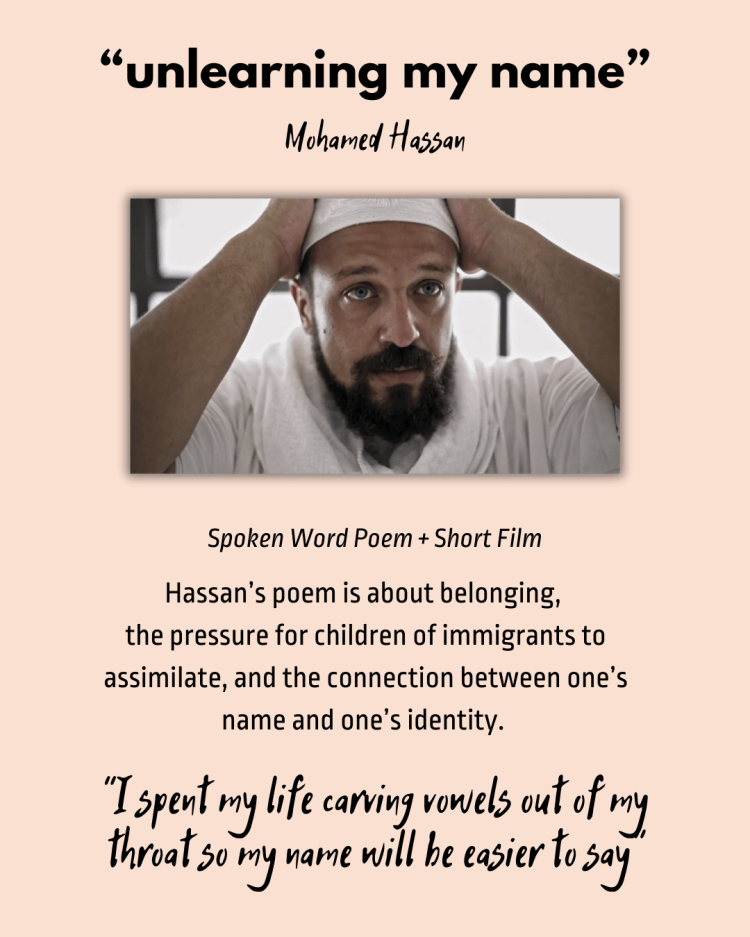
“Unlearning My Name” by Mohammad Hassan
This poem changed me. I watched it in 2019, and I think about it so often.
For many children of immigrants, the first compromise we make between our conflicting cultures is often on how to say our name. Many of us have a name from our parents’ homeland, but accept a form of our name that has been changed by the accent of our birthplace.
I was not brave enough to insist on a correct pronunciation of my name until I was 32 years old. And by then, it was weird to hear the right sounds that go with my name. Hassan’s repetition of his first name, as he trains his ears to hear his own name correctly, is exactly what I experienced then and to this day. I, too, chant my name to myself, wondering if I’m saying it right, if I’m an impostor, if I’ll ever find peace with my identity.
How I used it in the classroom
I was only able to truly fit this text in once in the past four years. It was at the end of an American Studies independent reading project in which students were tasked with reading one book that gave them a deeper understanding of the many different cultures and peoples that make up the American identity. It was an intentionally broad prompt so that students could look into anything, but we hoped that they found a text that helped them understand their own culture or one other culture better. Book ideas included titles such as The Namesake, Homegoing, and There, There.

At the end of our independent book study, we held “medium group” discussions. Rather than do a huge, whole-class discussion that would result in the introverts hiding behind the extroverts, we split the class in half and did a Harkness-model discussion.
We had a small group of 17 kids that year, and more than half the class was comprised of children of immigrants. I had a feeling that many of them would have a similar relationship with their American identity as I did: feeling split, yearning for connection, yet never really feeling like I belonged anywhere. To get kids to feel comfortable with talking about the complexity of our identities, we played Hassan’s poem and this Ancestry.com commercial before starting our discussion:
I remember the heavy, thoughtful silence and the emotion in the room after we played those videos. Our discussion afterwards was gorgeous and powerful, in which our students went deep into the nuances of American identity. This is the type of thought that goes into developing a “sophisticated” thinker in AP terms.
Daniel “Jun Ho” Lee by Kevin “Jin Kwan” Kim
This video made me cry with how much I related to it. Whereas “Unlearning My Name” is more of an adult perspective on how names affected one’s identity, “Daniel” connects more to the conflict tied to a name during childhood.
I discovered this video on TikTok right when we were about to move into the final phase of a semester-long project in American Studies. It was a perfect exemplar of a creative argument in video form.

How I used this in the classroom
During fall semester, our American Studies students were tasked with figuring out what defined the American identity. For each APUSH period we covered, they had to analyze various texts (essays, paintings, poems, etc.) and reflect on what each revealed about American culture and values. At the end of the semester, students had to synthesize their learning into an argument that answered the question: “What is an American?” Their final piece was a creative representation of their argument.
I used this video to launch into the final phase of that project. Students often need a sample of their final product. I try to avoid showing too many student samples from previous years, because this tends to make students try to figure out a formula to get an A.
Kim’s video worked well as a launch because it answered the question (close enough–this is about a Korean Canadian… but the kids got the gist, and I was open about the difference), it is short, and it felt “professional” and like “rhetoric in the wild” rather than just another school project.
Kim also created another equally powerful short film that I could have used interchangeably, called “Halmeoni”:
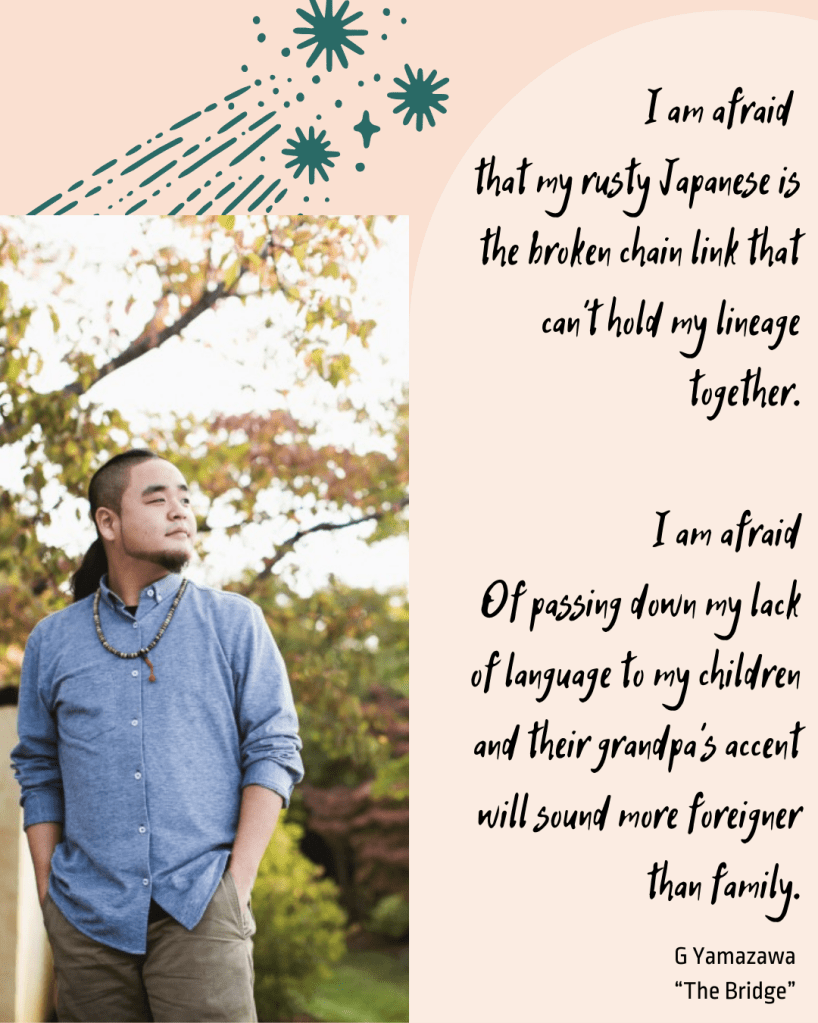
“The Bridge” by G Yamazawa
This is a piece I will move mountains for.
A candid, relatable spoken word poem, this piece connects so much with my Asian American student population. Looking back on the ELAR curriculum I had as a kid growing up in the 90s, any Asian representation was a rare treat, and Asian American representation was even rarer. As a parent myself, I often think about his words on losing connection with his parents’ language and what that means for his own children.

How I used this in the classroom
Like I said, I will move mountains for this piece. It is so powerful and I have gotten such a positive response to this poem from my students that I will find a way to fit it in my lessons.
10th grade Honors English: I used this as part of a lesson called “Is It Poetry?” In this lesson, I gave students varying types of poetry, from classic Romantic pieces, to Instagram poets, to slam poetry, and asked them to make an argument about what defines poetry.
American Studies (11th grade, AP Lang + APUSH): I have used these at various points in the year, depending on our curriculum and how the units flow. Most recently, I presented it as a launch into the AmStud course. Students watched the performance, we discussed its meaning and its argument, and we used it as a way to show how our course will look at the rhetoric in art as well as discuss the complexities of the American experience.
Bring in all the perspectives that you can
“We read to know we are not alone” is one of my favorite quotes and a guiding principle in my life. The more perspectives our kids have in the ELAR classroom, the better. Texts to see themselves, texts to see their peers, texts to see this complex human experience that we’re all swirling in.
I know that many of us teachers in the US are also struggling with the censorship that’s so rampant in the country lately. I’m aware that some or all of these videos I shared may not be allowed in some districts. Do what you can to keep your job and also do right by your kids.
As an Indian American kid growing up in the 90s, I never saw my experience in the texts that I read in the classroom–until I flipped through the pages of my AP Lit textbook during my senior year of high school and read “Indian Movie New Jersey.” To see that the simple experience of watching an Indian movie in a US theater written in poetic form and included in a textbook–I cannot explain to you how magical that felt. It was like I could suddenly see in color after living in black and white. After always feeling a little like an outsider everywhere I went, I finally felt included.
Every person deserves to feel that level of magical connection to what they read and experience in the classroom.
That’s why we need to fight to help each of our students feel seen and included.

 NLD x Swapna